Analysis
User testing · usability testing
Can test participants use your product? We observe them completing tasks and record where they need help.
US$3,349.00
Total price · one-offVAT-exempt under section 19 of the German VAT Act
User interviews, usability testing and UX/UI design for websites, stores and web apps. We investigate your team's open questions and turn the findings into specific designs and development tasks.
Are you planning a function, testing a prototype or improving an existing application? That decision determines the work. User interviews explore experiences and workflows. Usability testing shows how people use a particular interface. Design work needs both requirements and an understanding of the domain.
We establish what you want to decide after the study. That guides the choice of participants and tasks. A conversation about a recent purchase answers different questions from a test of the cart. Participant criteria and recruitment are agreed before the study starts.
A finding identifies where a task breaks down, what was observed and what still needs explaining. We separate observation from interpretation. Priorities depend on the task, the severity of the problem and technical constraints. The number of comments alone does not determine what to change first.
UX Design includes more than the ideal path: missing information, empty lists, failed actions and returning after an interruption all matter. A prototype makes selected flows testable before development. We choose its level of detail to match the question that remains open.
Each service page sets out its scope and current price. Your selection is a non-binding enquiry; we clarify outstanding questions before you commission the work.
Can test participants use your product? We observe them completing tasks and record where they need help.

We speak to people from an agreed audience about the research question. You receive a thematic analysis of their comments and open questions.
You are choosing between product options. We compare them using your existing materials and write a decision brief.
To start, tell us which decision you need to make, which flow is involved and who uses it. Existing support questions or a prototype often help identify what needs a closer look; we can discuss limited test access where needed. We agree whether you need only a report or also support with design and implementation, and define the scope accordingly.
Luka focuses on Product Design, UX and CRO. Elisabeth contributes research and visual product explanation. Andrejs and Arad can support questions about implementation. Their specific involvement is agreed for each project.
Meet the team

We are based in Bassum near Bremen and work with teams across northern Germany, Germany, Austria and Switzerland, as well as internationally. We collaborate remotely in English or German, with on-site meetings by arrangement. Together, we agree how to coordinate the work and which deliverables your project needs.
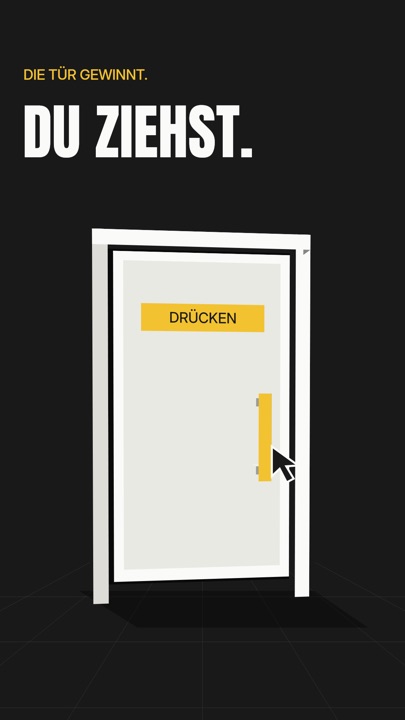
You pull a door that you are supposed to push: its shape has already given you the wrong expectation. Buttons and other interface controls can do the same thing.
A UX agency helps investigate unresolved product questions using appropriate material. The observation needed for a decision determines the study and subsequent design.
An upcoming decision is the starting point for UX consultancy. A team may want to know whether a new function is needed or whether people understand an existing journey. These are different questions. The first concerns experiences and tasks; the second concerns interaction with a specific interface.
Describe what should be decided after the study. Existing support questions, a prototype or an observed abandonment help narrow the focus. A general wish for better user experience leaves unclear which change needs examining. A bounded question makes findings easier for product, design and development to use.
User interviews can reveal how people currently work and which information they need. A usability test allows observation of how they complete a task with a product. Someone liking a function does not mean they can find it independently in a test or will need it in everyday work.
Planning therefore considers participants, starting state and task wording. Selection should match the intended use. An experienced user and a new prospect bring different knowledge. Recruitment and study delivery are agreed within the relevant scope; an expert review does not automatically include a full user study with newly recruited participants.
A UX audit needs traceable findings. “The navigation is poor” does not describe where a task fails. It is more useful to record the label someone expected, the route they took and where they needed help. The explanation remains an interpretation until sufficiently supported.
Prioritisation depends on the affected task. A rare error may be critical if it prevents completion; a frequently mentioned detail may be less urgent. Known technical dependencies also belong in the assessment. This turns a report into a justified sequence that guides the next design and development work.
A finding’s form should serve the next step. For a design change, your team needs the affected decision and context. A technical correction also needs expected behaviour. A traceable finding therefore remains useful when someone else implements it or work begins after the initial results discussion.
UX/UI design translates requirements into views and behaviour. A prototype needs a defined research question. An early design can show an information sequence; a more detailed journey can represent selection, feedback and correction. Not every investigation already requires technical implementation of every function.
At handover, it should be clear which findings have been addressed and which questions remain. Development needs states and rules extending beyond an ideal screen. Whether SAND & MEHR only investigates, also designs or subsequently develops is defined in the relevant offer. Your existing team can therefore take over the results too.
Whether you want to improve an existing website or develop a new application, it helps us to understand which task is difficult today and what you want to change. You can include your website link or a short description in your enquiry.
Discuss your project